

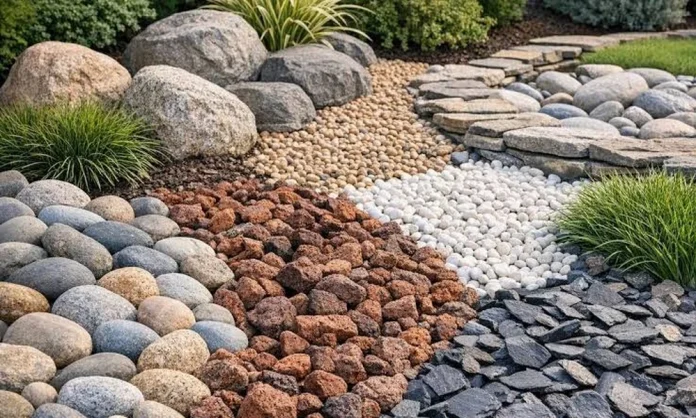


Nobody warns you about the pile. You spend a weekend picking the perfect grayish-tan gravel, the truck dumps three cubic yards at the top of your driveway at 7 a.m., and you spend the next two days moving it one wheelbarrow at a time while your back files a formal complaint. Stone selection gets all the attention online. Stone logistics is what actually decides whether your weekend works out.
Most homeowners figure that part out around wheelbarrow number forty. Contractors figure it out before they order, which is the only real advantage they have over you. By the end of this you’ll know which stone fits driveways versus paths versus beds, how deep to spread each one, and roughly how many cubic yards your project will swallow.
What each stone type is actually good at
Bulk stone isn’t a style. It’s a volume. A quarry sells it loose by the cubic yard instead of in bags, so you’re buying weight and coverage, not a product name on a shelf. From there, the material only needs to do one of two jobs: stay put under load, or look good where nothing gets driven on.
Crushed stone is the one that stays put. Its rough, angular faces interlock when they’re compacted, so they form a surface that carries weight without squirming around. If you’re topping a driveway or building one, this is your material.
Decorative stone is the one that looks good. Rounded and polished types like river rock, egg rock, and pea gravel roll underfoot instead of locking together, which is exactly why they don’t belong on a slope you plan to walk up in dress shoes. In a planting bed or dry creek bed, though, they’re hard to beat. I’d take warm river rock around a patio every time. I wouldn’t take it near a driveway.
Match the size to the job
Here’s the part most buying guides skip, because it’s less fun than photos of pretty gravel. Stone size rules follow performance, not aesthetics. Nowhere does that show up more than on the driveway, where the wrong stone disappears into the mud in a single muddy season.
- Sub-base layer: 2A modified stone, roughly ¾ inch with the fines left in. It compacts into a hard, near-concrete plate and carries the weight.
- Surface layer: 2B clean stone or 1B clean stone. Washed and free of dust, these drain fast and lock together on top of the base.
- Beds and borders: anything from ½ inch decorative stone up to 2 to 4 inch goose egg. Rounded, pretty, zero load-bearing.
- Pathways and dry creek beds: 1 to 3 inch river rock moves quietly underfoot and drains well where water wants to run.
One size never does both jobs. If you use 2B clean stone as your only base layer, water thinks it’s found a culvert, and you’ll be releveling that driveway next spring. If you top a driveway with rounded egg rock, the tires push it aside like marbles and your base is exposed by August.
There’s a genuine quality gap to watch for too. Crushed limestone lives in the softer end of the mineral spectrum. Sedimentary rock tends to have lower compressive strength than igneous rock like granite, and that shows up when heavy vehicles and freeze-thaw cycles go to work on it. If your driveway sees a loaded work truck more than once a season, the harder material earns its price. The U.S. Geological Survey publishes the baseline data on stone production and use if you want a sense of what’s even available in your region.
If you’re ordering in the Bux-Mont area, working with a landscaping bulk stone supplier Souderton contractors already buy from means you can see the actual material before it lands on your driveway. That’s worth a lot when color and particle size are the entire decision.
How deep should you spread it?
Depth beats color on the list of things that ruin stone projects. Too thin and the stone migrates into the soil underneath. Too thick and a walking surface turns into a hiking trail.
- Garden beds: 2 inches over good soil. Enough to suppress weeds without burying the crowns of your perennials.
- Walkways: 2 to 3 inches, compacted, over a properly excavated and leveled base.
- Driveways: 4 inches of compacted base plus 2 inches of surface stone is the standard recipe.
- Water features and dry creeks: 3 to 4 inches of rounded rock, tucked over a liner where applicable.
For driveways, the base isn’t the part you see. It’s the part that keeps you from calling someone out to fix ruts every eighteen months.
How much do you actually need?
This is where an expensive mistake hides. Stone is sold by volume, not area, and buying too little means paying a second delivery fee while half a driveway sits unfinished. The math is honest and worth doing before you call.
Length times width times depth, all in feet, then divide by 27. That gives you cubic yards. A 12 by 20 foot driveway section at 4 inches deep needs just under 3 cubic yards. A 2 inch deep layer over a 10 by 30 foot path wants closer to 2 yards. The same math applies to beds, and it’s why experienced buyers order the extra quarter yard rather than running short.
Labor capacity matters just as much as the number. Spreading a cubic yard of stone runs roughly an hour and a half per yard with a wheelbarrow and no help. Three yards is a weekend. Six yards without a machine is a mistake you’ll feel on Monday. Ordering more of a cheap stone to avoid a second delivery, then paying yourself in sore muscles, is a bad trade. Order the amount you can actually move in the time you have.
The physical end of this work is real work, which is why stone work keeps landing on hiring lists. According to the Bureau of Labor Statistics, landscaping and groundskeeping roles remain among the most common outdoor occupations in the country, which tracks with how many homeowners end up hiring out the heavy lifting instead of doing it themselves.
The checklist worth running before you order
- Write down the job: base layer, surface layer, or decorative cover.
- Pick crushed and angular for load, rounded and pretty for looks.
- Decide the depth from the list above, not from the pile’s height.
- Measure in feet, run the length times width times depth math, divide by 27.
- Ask about delivery windows and whether the truck can drop at the far end of the work zone instead of the front curb.
- Buy a small bag of the exact stone first, spread it in one spot, and check it in daylight. Rust tones in quarry red look fantastic in a photo and fight with brick that’s a shade off.
Penn State Extension is a good free reference for drainage and ground-cover questions if your project sits on a slope or floods, and its guidance on home ground conditions is written for exactly this kind of work rather than for contractors bidding a job.
What quicksand-sized mistakes look like
The most common flop I hear about is a bed covered with rounded river rock sitting half an inch from a driveway. There’s no border, so the stone migrates onto the pavement, then into the street, then into a neighbor’s lawn conversation. Separate zones, separate materials, and a visible edge between them if you want either one to stay put.
The second is ordering decorative rounded stone for a surface that takes traffic, because the photo of a driveway at dusk featured warm-toned rock. Check the product’s job, not the render. Price per ton also shifts with material and quarry proximity, so a quote for red tipple stone and a quote for basic crushing dust are not competing quotes. They’re different products.
Get the type right, the depth right, and the yardage right, and the pile stops being a problem and turns into the easiest part of the project. Call your local yard, ask what’s actually in stock, and put your hands on the stone before you commit a trailer to it. What’s the stone on your driveway right now doing in a hard rain, staying put or heading downhill?