

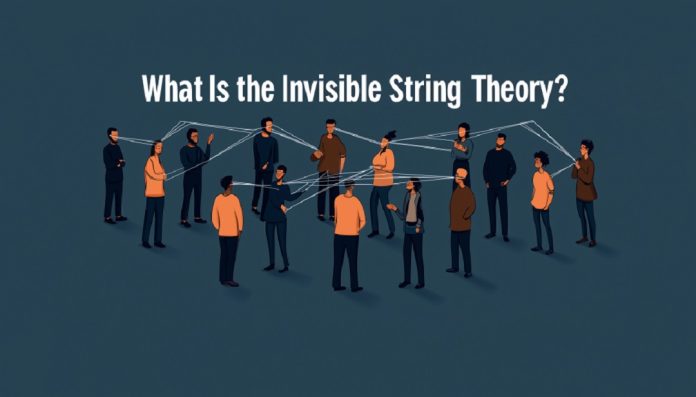


The invisible string theory is a spiritual and philosophical belief that every person who is meant to be in your life is connected to you by an invisible thread. That thread may stretch, tangle, and pull across years and distance, but never truly breaks. It is the idea that meaningful connections are not accidents.
The concept originates from an ancient East Asian belief known as the Red Thread of Fate, rooted in Chinese and Japanese folklore. In China, it is called Hong Xian (the red thread), and it is said to connect people who are destined to meet, particularly soulmates. The thread is tied at the ankle or finger and is invisible to the eye but unbreakable by circumstance.
The Cultural Roots of the Invisible String
| Culture | Name | What It Connects | Where It’s Tied |
|---|---|---|---|
| Chinese | Hong Xian / Red Thread of Fate | Destined romantic partners | Finger (pinky) |
| Japanese | Unmei no Akai Ito | Soulmates, fated individuals | Finger |
| Korean | Inseong / Red String | Connected souls across lifetimes | Finger or wrist |
| Western (modern) | Invisible String Theory | Any meaningful relationship | Metaphorical |
| Hindu | Thread of Karma (Sutra) | Souls bound by past actions | Metaphorical |
What started as a specific belief about romantic destiny in East Asian cultures has broadened considerably in modern Western interpretation. Today, people apply it to friendships, mentors, strangers who changed their lives, and even places that felt strangely familiar.
Taylor Swift and the Cultural Moment
Many people encountered the phrase invisible string through Taylor Swift’s 2020 song of the same name on her album Folklore. The song traces the unspoken, unseen forces that led her to her partner – the jobs they each had, the places they walked past each other before they knew each other, the strange coincidences that aligned.
That song introduced the concept to millions who had never heard of Hong Xian. Suddenly, invisible string was being discussed on TikTok, Reddit, and Instagram as a framework for understanding how people end up in each other’s lives. The cultural moment gave an ancient idea a new, secular vocabulary.
The Science vs. The Belief
From a scientific standpoint, there is no evidence of a literal thread connecting people. What research does support is that humans are wired to find patterns and meaning – a cognitive tendency called apophenia. When we look back at our lives and see how person A led to person B who introduced us to the city where we met person C, our brains naturally construct a narrative of intention.
Psychologists call this retrospective sense-making. It is not delusion – it is a fundamentally human way of processing a complex, random world. Whether the thread is real or constructed, the comfort it provides is genuine.
Why People Find the Idea So Comforting
- It reframes loneliness as temporary. If the thread exists, disconnection is never permanent.
- It makes loss easier to bear. When relationships end, the belief holds that the connection itself does not disappear.
- It reduces anxiety about the future. Trusting that the right people will find you removes pressure from forced networking and social performance.
- It gives meaning to random encounters. The stranger who gave you advice at the right moment. The friend you lost touch with who reappeared exactly when you needed them.
There is something quietly radical about a belief that says the most important things in your life are not entirely within your control – and that is okay.
The Modern Interpretation: Beyond Romance
One of the most meaningful shifts in how people use the invisible string concept today is its expansion beyond romantic love. The original folklore was mostly about finding a life partner. Modern usage applies it far more broadly:
- The teacher who believed in you before you believed in yourself.
- The book you picked up by accident that changed how you think.
- The city you moved to on a whim that turned into home.
- The friend you almost did not message who became your closest confidant.
In this expanded version, the invisible string is not about fate handing you a perfect partner. It is about the texture of a life well-lived – full of connections that feel, in retrospect, like they could not have been otherwise.
A Thought Worth Keeping
Whether you believe in fate, karma, or none of the above, the invisible string theory offers something useful: a way of looking at the people in your life and recognizing that their presence is not ordinary. Something brought you together. Maybe that is enough.