

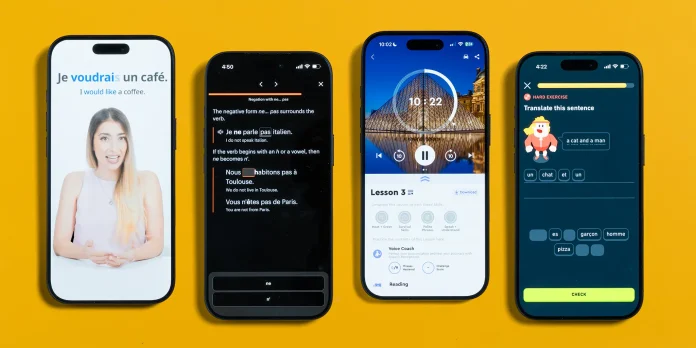


Top 7 Language Learning Apps Compared
| App | Best For | Languages | Price | Method | Offline? |
|---|---|---|---|---|---|
| Duolingo | Habit building, beginners | 40+ | Free / $6.99/mo | Gamified lessons, XP system | Yes (paid) |
| Babbel | Conversational fluency | 14 | $8.99/mo | Structured dialogue-based curriculum | Yes |
| Pimsleur | Speaking & pronunciation | 50+ | $19.95/mo | Spaced repetition audio lessons | Yes |
| Rosetta Stone | Immersive visual learning | 25 | $11.99/mo | Image-word association, no translation | Partial |
| italki | Real human tutors | 150+ | $10-$30/hr | 1-on-1 video lessons | No |
| Anki | Vocabulary retention | Any | Free | Flashcard spaced repetition | Yes |
| Clozemaster | Intermediate/advanced learners | 50+ | Free / $8/mo | Fill-in-the-blank in context | Partial |
Deep Dive: The Top Three
Duolingo – Best for Staying Consistent
Duolingo’s genius is not its teaching method – it is its retention engineering. Streaks, leagues, daily goals, and animated characters that guilt-trip you if you miss a day. It sounds manipulative because it kind of is, and it works.
For true beginners, Duolingo builds vocabulary and basic grammar patterns effectively. The gamification keeps people engaged longer than more academic approaches. The free tier is genuinely usable. The paid Super Duolingo removes ads, adds offline access, and allows unlimited hearts (mistakes).
Where it falls short: the lessons can feel disconnected from actual conversation. You will learn to translate sentences before you can say ‘where is the bathroom’ with confidence. Supplement with speaking practice.
Babbel – Best for Practical Conversation
Babbel’s lessons are built around realistic dialogues – ordering food, navigating airports, meeting new people. Every lesson has a clear conversational payoff. The curriculum feels like it was designed by actual language teachers, because it was.
The speech recognition feature gives genuine pronunciation feedback. Lessons run 10-15 minutes and are designed to be completed on a commute. After three months of consistent Babbel use, most learners can handle basic travel conversations in their target language. That is a concrete, measurable outcome worth paying for.
Pimsleur – Best for Speaking and Listening
Pimsleur is the oldest method on this list – developed in the 1960s by linguist Paul Pimsleur – and it remains uniquely good at one thing: getting speech out of your mouth correctly. The lessons are entirely audio-based. You listen, repeat, and respond. There is nothing to read or write.
This makes it ideal for commutes, walks, and gym sessions. It is the best app for people who specifically want to speak and understand the language rather than read it. The price is high relative to competitors, but the method is genuinely different from everything else on this list.
Choosing by Learning Goal
| Your Goal | Best App(s) | Why |
|---|---|---|
| Just starting out | Duolingo | Zero friction, free, builds habit first |
| Traveling soon | Babbel + Pimsleur | Practical phrases + correct pronunciation |
| Want to speak fluently | italki (tutors) + Anki | Nothing replaces human conversation |
| Vocabulary building | Anki or Clozemaster | Spaced repetition is the gold standard |
| Intermediate plateau | Clozemaster + italki | Context-based learning + real feedback |
| Academic / exam prep | Babbel + tutor on italki | Structured grammar + tested speaking |
| Kid-friendly learning | Duolingo (Kids version) | Designed specifically for children |
Free vs Paid: Is It Worth Paying?
Duolingo Free: Completely usable. Ads are mildly annoying but not disruptive. The free tier gets you 80% of the core learning value.
Babbel ($8.99/mo): Worth it. The curriculum depth is meaningfully better than free alternatives.
Pimsleur ($19.95/mo): Expensive but justified if speaking is your primary goal. No free tier has this audio depth.
italki ($10-$30/session): The single best investment in language learning. Even one session per week with a community tutor accelerates progress dramatically.
Common Myths About Language Apps
- ‘You can become fluent with an app alone.’ No app has achieved this for adult learners. Apps build components; fluency requires real use.
- ‘More expensive means better.’ Duolingo is free and beats several paid competitors for habit formation and beginner content.
- ‘You need to live in the country to learn the language.’ Immersion helps but is not required. Consistent daily practice over 1-2 years produces real results anywhere.
- ‘Children learn faster because of apps.’ Children learn faster because they are in total immersion environments, not because their apps are better.
The Honest Bottom Line
Pick one app and use it every day for 90 days before judging it. Most people who fail at language learning do not fail because they chose the wrong app – they fail because they quit in week three when the novelty wears off.
If you are a beginner: start with Duolingo, add Babbel once you have a streak going. If you want to actually speak the language, book one session on italki within your first month. That single conversation will teach you more than 30 days of solo app use.